Nature Geoscience:Study Reveals New Mechanism for Rapid Methane Release from Subglacial Gas Hydrate Systems in Polar Regions
Nature Geoscience:Study Reveals New Mechanism for Rapid Methane Release from Subglacial Gas Hydrate Systems in Polar Regions
Recently, Associate Researcher Jiliang Wang from the Institute of Deep-sea Science and Engineering, Chinese Academy of Sciences, together with an international team from the University of Manchester, Queen's University Belfast, and the Geological Survey of Denmark and Greenland, published a new study in Nature Geoscience. Their research reveals a previously unknown feedback mechanism between methane hydrates and climate change. The study confirms that during deglaciation, meltwater-driven groundwater flushing can cause rapid "dissolution" (diffusion-dominated) of methane hydrates in marine sediments. This finding implies that greenhouse gas release triggered by climate warming in polar regions could occur much faster and more intensely than previously anticipated by the scientific community.
Continental margins and permafrost regions worldwide store approximately 1,800 gigatons (Gt) of methane, constituting one of the largest methane reservoirs in the global carbon cycle. It was conventionally believed that with global warming or sea-level fall, temperature and pressure changes would cause thermodynamic dissociation of hydrates, subsequently releasing large amounts of methane. However, due to low thermal diffusion rates and latent heat effects, thermodynamic models estimate that warming-induced dissociation and release could take thousands of years. Consequently, gas hydrate destabilization has been viewed as a slow climate feedback process with little impact on centennial timescales.
The research team conducted a systematic analysis of the gas hydrate system on the northwest Greenland continental shelf, integrating core data from International Ocean Discovery Program (IODP) Expedition 400 with three-dimensional reflection seismic data. The seismic profiles clearly identified bottom-simulating reflections (BSRs) and underlying free gas, indicating sufficient methane sources in the area. However, within the hydrate stability zone, where methane should theoretically be abundant, the IODP boreholes detected extensive "low-methane, low-salinity" anomalies. Furthermore, widespread seafloor pockmarks on the seaward of the grounding-zone wedge provided evidence of large-scale past fluid evacuation in the region.
Combining these evidences, the research team proposed a new model of hydrate destabilization: during the last glacial cycle, the large subglacial hydraulic gradient generated by ice-sheet melting drove local groundwater flow. Large volumes of fresh water derived from glacial meltwater infiltrated downward, flushing subglacial sediments. This low-salinity, methane-undersaturated fresh water directly infiltered into the gas hydrate stability zone, bypassing temperature and pressure constraints. Like "warm water dissolving sugar," it triggered rapid hydrate dissolution, thereby releasing substantial methane into the ocean.
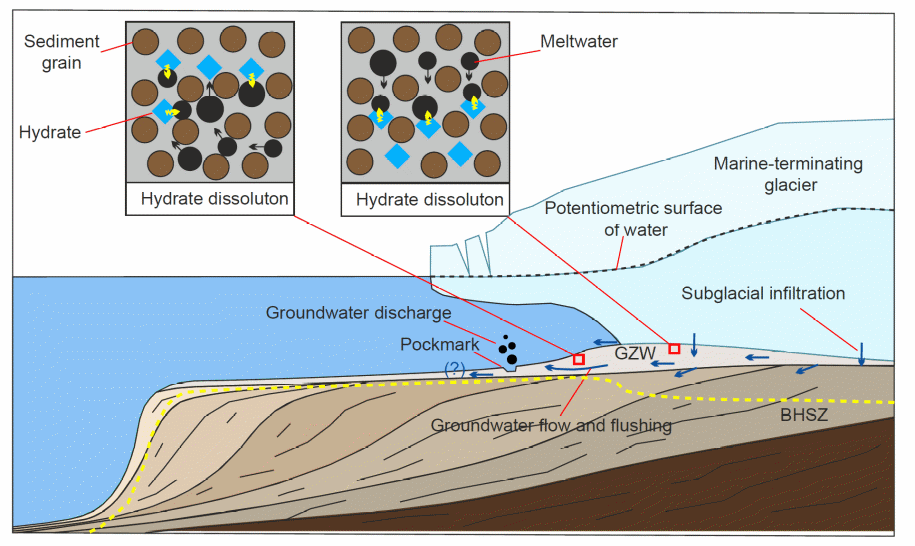
Fig. 1 | Conceptual model of methane hydrate dissolution triggered by subglacial meltwater flushing
This discovery confirms that the gas hydrate stability zone does not completely "lock up" methane. Compared with the hydrate dissociation mechanism, which requires timescales of thousands of years, the meltwater flushing mechanism responds extremely rapidly—it can be activated as soon as temperatures rise above freezing. This implies that the polar hydrate systems, which store vast amounts of carbon, are far more sensitive to climate warming than current models predict.
With the accelerating retreat of the Greenland and Antarctic ice sheets, hydrate dissolution driven by subglacial meltwater flushing is expected to become a crucial but as-yet-unaccounted pathway in future polar carbon cycle feedbacks. When predicting future polar climate feedbacks, in addition to conventional temperature and pressure conditions, it is essential to incorporate hydrological processes, basin geometry and ice-sheet dynamics in high-latitude settings. This holds great scientific significance for understanding the dynamic evolution of greenhouse gases under past, present and future climate scenarios.
Reference:
Wang, J., Newton, A. M. W., Huuse, M., Cox, D. R., Perez, L. F., Knutz, P. C.. Gas hydrate dissolution triggered by subglacial groundwater flushing during deglaciation. Nature Geoscience (2026). https://www.nature.com/articles/s41561-026-01978-3.
 Copyright © Institute of Deep-sea Science and Engineering,CAS

